


Sweetness is a natural preference formed during human evolution. In ancient times when food was scarce, the ability to quickly identify sweetness meant finding a safe source of energy—an instinct deeply embedded in our genes.
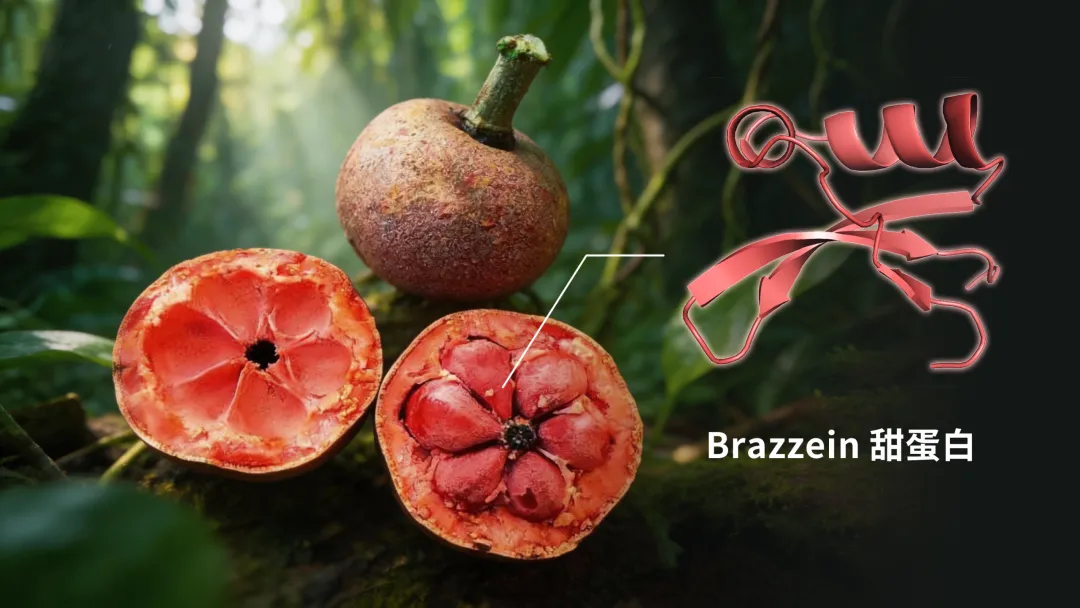
Today, as the craving for sweetness meets the demands of modern health management, the food industry is seeking new solutions. Amid the global trend of sugar reduction, Brazzein, a natural sweet protein derived from the fruit of Pentadiplandra brazzeana, a plant native to the tropical rainforests of West Africa, offers a new possibility for balancing taste and health.
Structural Stability: High Stability Enabled by a Sophisticated Structure
Brazzein is one of the smallest known sweet proteins. In its natural state, it exists as two isoforms composed of 54 and 53 amino acids, respectively. Its molecular structure contains four pairs of disulfide bonds that firmly link the protein structure, endowing it with considerable thermal stability.
Experiments have shown that Brazzein can withstand instantaneous high temperatures of nearly 138°C (internal laboratory test data), maintaining structural and functional integrity during heating processes such as sterilization and filling in food and beverage production. This characteristic addresses the issue of denaturation and loss of function that protein-based sweeteners often encounter in applications.
Through these interconnected steps, catalyzed by the precise synergy of enzyme preparations, hard starch is efficiently converted into clear, sweet starch syrup.
This gentle and efficient enzymatic process forms the foundation for the modern food industry to produce a variety of starch sugar products stably and economically.
Precise Recognition: A Multi-Site "Lock-and-Key" Mechanism
Why is Brazzein thousands or even tens of thousands of times sweeter than sucrose? This stems from its unique interaction with the human sweet taste receptor (T1R2-T1R3).
Human perception of sweetness is akin to a "key" opening a "lock." Sucrose, a small-molecule carbohydrate, primarily triggers a signal by embedding itself within a specific pocket at the top of the sweet taste receptor. This is like an ordinary key that must be fully inserted into the lock to work. In contrast, Brazzein, as a protein with a three-dimensional structure, functions more like a specially designed key with multiple anchoring points. It not only interacts with the core binding site but also uses multiple amino acid clusters on its surface to engage in robust interactions with various external regions of the receptor simultaneously.

Compared to sucrose, Brazzein's unique surface amino acid clusters act like a "multi-point anchoring master key," precisely activating the T1R2-T1R3 receptor to deliver a potent, pure sweetness signal.
This multi-site, extensive binding allows Brazzein to firmly "anchor" onto the receptor like a magnet, activating a strong sweetness signal at very low concentrations. Moreover, due to its high specificity in binding, it does not activate receptors associated with off-flavors like bitterness, resulting in a smoother, cleaner taste experience with a refreshing aftertaste that does not interfere with the natural flavors of the food itself.
Green Manufacturing: From Forest Harvest to Precision Fermentation
Brazzein was initially discovered in a berry called Oubli in the West African rainforest, but its natural content is extremely low. Relying on wild harvesting and plant extraction is not only costly but also insufficient for large-scale supply.
Today, this bottleneck has been overcome by advanced precision fermentation technology. Similar to brewing beer or making yogurt, fermentation is a safe, established biomanufacturing process. In clean, fully enclosed modern production lines, raw materials like starch sugars are efficiently converted into high-purity Brazzein.
This production method does not rely on plant extraction, enabling large-scale production and significantly reducing application costs. The process does not occupy arable land and consumes minimal water, aligning with principles of green and sustainable development. Additionally, because the production conditions are precisely controlled, it ensures long-term supply chain stability, robustness, and product purity.
Mellia® Brazzein: The Balanced Choice for Health and Flavor
As a natural protein, Brazzein delivers a sweetness perception similar to sucrose, allowing consumers to enjoy a sense of satisfaction without adding caloric burden.
As an innovator in the field of biotechnology, Bestzyme has successfully achieved large-scale production of Brazzein sweet protein through its synthetic biology platform. Its Mellia® Brazzein boasts properties such as high sweetness, high stability, and a clean taste profile. It can also enhance natural flavors like fruit, tea, and milk notes, making it widely applicable in categories such as beverages, dairy, confectionery, and health supplements, providing a "zero-calorie" protein-based sugar reduction solution.
In terms of regulatory progress, Mellia® Brazzein successfully obtained FDA GRAS (Generally Recognized as Safe) certification in the United States in April 2025, becoming the first Brazzein product from China to receive this authoritative recognition. This not only validates the product's safety but also signifies Bestzyme's leading edge in global innovation and research into natural sweet proteins. Currently, Bestzyme is actively pursuing regulatory approval for this product in the Chinese market, committed to providing domestic consumers with a superior natural sugar reduction solution in the near future.
In an era where sugar reduction and clean labels are prevailing trends, Bestzyme Mellia® Brazzein offers the food industry a natural and reliable choice. It empowers companies to develop low-sugar and zero-sugar products without compromising on taste or formulation, building consumer trust with a simpler ingredient list. Bestzyme looks forward to partnering with you to usher in a new chapter where health and deliciousness coexist.
References:
[1] Assadi Porter F M , Maillet E L , Radek J T ,et al.Key amino acid residues involved in multi-point binding interactions between brazzein, a sweet protein, and the T1R2-T1R3 human sweet receptor.[J].Journal of Molecular Biology, 2010(4):398.
[2] Picone,Temussi,PA.Dissimilar sweet proteins from plants: Oddities or normal components?[J].Plant Science, 2012.
[3] Temussi P A .Natural Sweet Macromolecules: how Sweet Proteins work[J]. Cellular and Molecular Life Sciences, 2006, 63(16):1876-1888.DOI:10.1007/s00018-006-6077-8.
© Bestzyme. All rights reserved.

